Edition of 20/08/2026
Sound that has to leave the room
Everything here is about the same problem, seen from different sides: a voice or a song exists in one place, and something has to carry it, unchanged enough to be recognised, to somewhere else. Ten long pieces, written to be read all the way through.
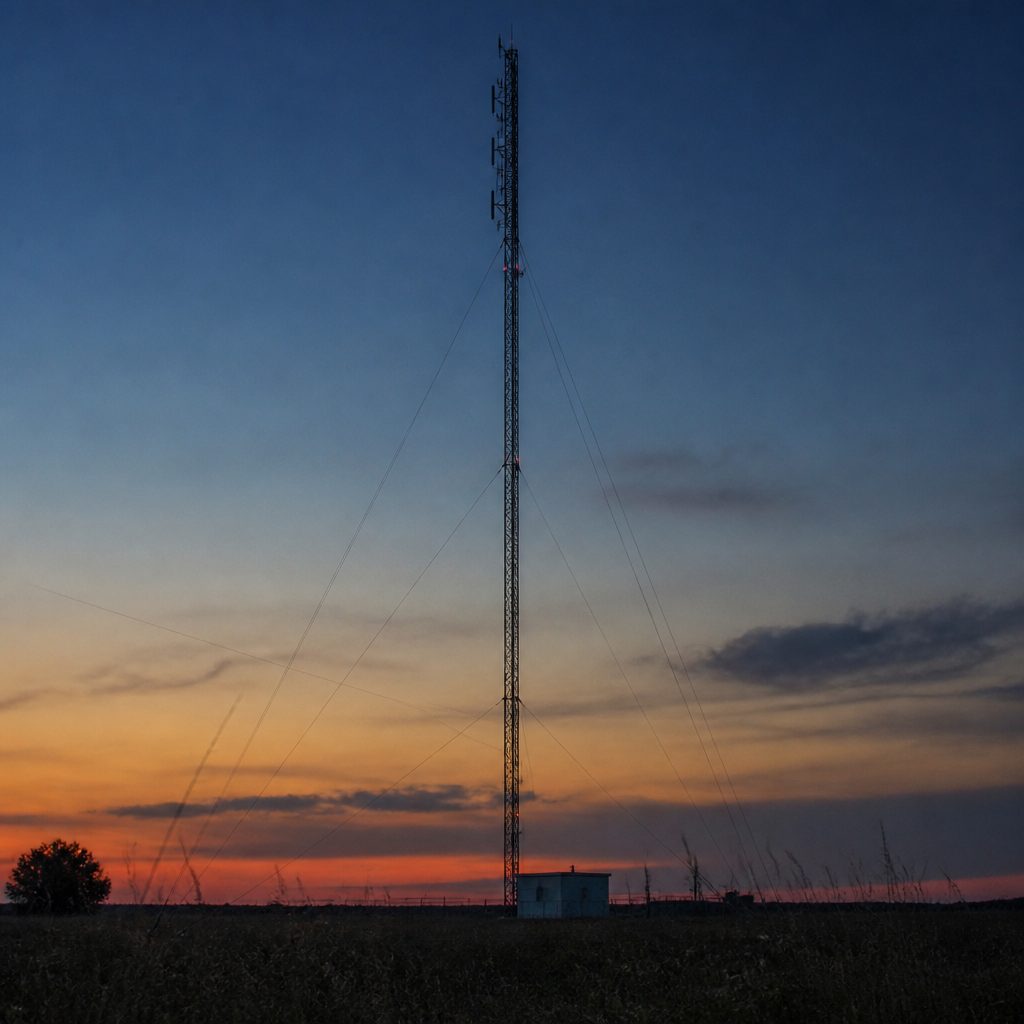
Radio is the oldest working answer to that problem, and it is still the one that explains the rest. Every idea a podcast producer uses in 2026 was first argued about in a transmitter building: how loud is too loud, how much of a hiss a listener will forgive, how you keep a signal recognisable after it has been squeezed through something narrow. The words changed. The physics did not.
This site is a reading notebook. It takes one subject at a time, explains it from the first principle to the point where you could argue about it with someone who does the work, and stops. There are no downloads, no course, no newsletter, and nothing to buy. Where a number matters, the number is in the text; where a rule comes from a published standard or a federal regulation, the note at the end of the piece says which one.
Two sections hold everything. On Air follows the signal outward: how a carrier is modulated, why the AM band behaves differently after sunset, how far a licence actually lets a station reach, and how an emergency alert gets on the air in the middle of a song. In the Room stays behind the glass: microphones, the wiring of a studio, loudness measurement, the shape of a broadcast hour, how a format is built, and who gets paid when a record plays.
The pieces, most recent first
-
How an emergency alert interrupts a song
The two-tone attention signal, the data burst that carries it, and the chain of stations that still relays a message when the internet is the thing that failed.
13 minute read On Air 4 notes
-
Who gets paid when a record plays
Two separate copyrights sit inside every recording, and American broadcast law treats them very differently. The reason a podcast cannot simply play a hit song.
14 minute read In the Room 4 notes
-
How far a station is allowed to reach
Power is the part everyone quotes and the part that matters least. Height above average terrain, station class and the protected contour do the real work.
13 minute read On Air 4 notes
-
The wiring of a room that talks back
Console, hybrid, mix-minus, delay, and the link to the transmitter. Why a caller hears themselves if one subtraction is wrong, and what audio over IP changed.
13 minute read In the Room 3 notes
-
Why the AM band changes at sunset
A layer of the atmosphere disappears every evening and a local signal becomes a regional one. The licence conditions that exist only because of it.
12 minute read On Air 4 notes
-
Loudness, and the ceiling nobody can raise
What LUFS measures that a peak meter cannot, why broadcast targets and streaming targets differ by ten units, and what processing spends to buy loudness.
14 minute read In the Room 4 notes
-
What is actually riding on an FM carrier
A pilot tone at 19 kHz, a stereo difference channel folded around 38 kHz, station text at 57 kHz. How one frequency carries four or five separate things.
14 minute read On Air 5 notes
-
Microphones, and the six inches that decide everything
Why broadcast rooms are full of dynamic microphones, what proximity effect really is, and why the room matters more than the model number.
12 minute read In the Room 3 notes
-
A format is a promise about the next song
Rotation categories, separation rules, imaging and burn. How a station decides what plays at 4.20 in the afternoon, months in advance.
12 minute read In the Room 3 notes
-
The shape of a broadcast day
Dayparts, the hour clock, stopsets, the legal identification at the top of the hour, and the difference between a log and what was really transmitted.
13 minute read In the Room 4 notes
The two sections
-
On Air
The signal after it leaves the console: modulation, propagation, coverage limits and the alerting system that can take over the air at any moment.
-
In the Room
Everything upstream of the transmitter: microphones, wiring, loudness, the planning of an hour, the design of a format and the licences behind the music.
-
Glossary
Sixty-two terms defined in one or two sentences each, from AQH persons to voice tracking, with links back to the piece that explains each one in full.